
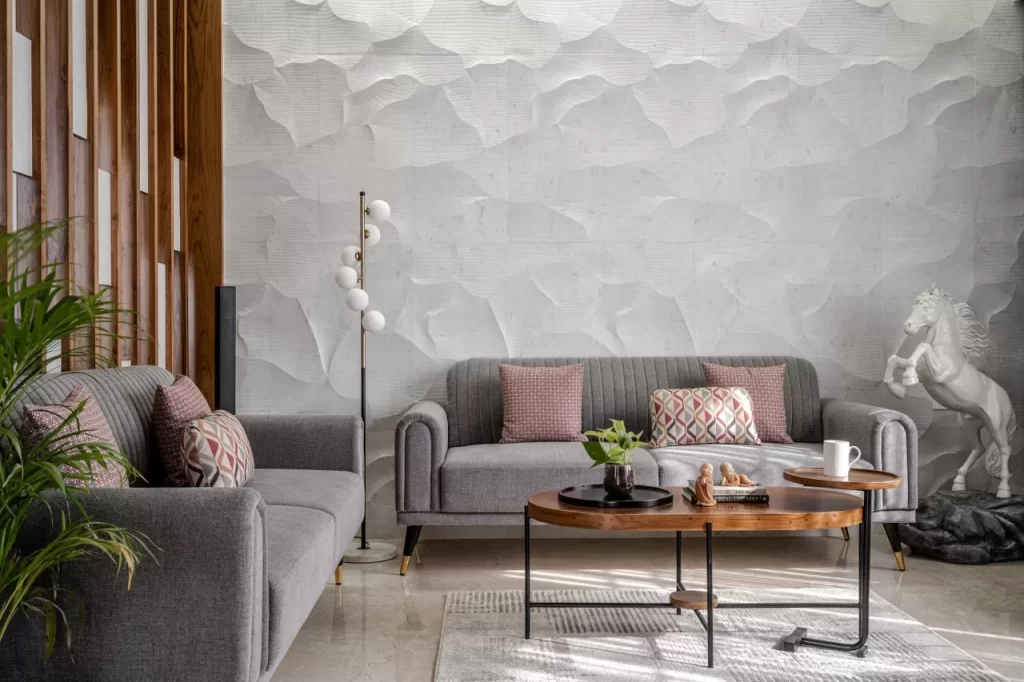
For years, smooth walls were seen as the ideal backdrop for modern interiors. Clean, neutral, and unobtrusive, they aligned perfectly with minimalist aesthetics. However, as interior design has evolved, flat surfaces alone are no longer enough. Today’s spaces demand depth, character, and sensory richness — a shift that has brought texture to the forefront of design. From plaster finishes to textiles and architectural surfaces such as wood veneered panels, texture has become a key tool in shaping how interiors feel and function.
The Limits of Smooth Surfaces
Smooth walls offer visual calm, but too much smoothness can make a space feel empty or unfinished. Without variation, the eye has nothing to engage with, and the room may lack warmth or personality.
Modern interiors still value simplicity, but simplicity no longer means flatness. Instead, it relies on layered surfaces that subtly interact with light, shadow, and materiality. Texture provides this layer without the need for excessive decoration.
Texture as a Sensory Experience
Interior design is not only visual; it is sensory. Texture affects how a space feels emotionally as well as physically. Rough, soft, matte, or grained surfaces all evoke different responses.
When walls are textured, even subtly, they contribute to a more immersive environment. The space feels considered and complete, rather than purely functional. This is especially important in contemporary homes, where fewer decorative elements must do more work.
Light and Shadow as Design Elements
One of the strongest arguments against perfectly smooth walls is how they interact with light — or rather, how little they do. Flat surfaces reflect light evenly, creating uniform illumination but minimal depth.
Textured walls respond differently. They catch light at various angles, producing soft shadows and highlights that support principles of biophilic design, where the interaction between surface, light, and material creates a more dynamic and human-centered environment. This effect shifts throughout the day, adding movement and visual interest and making the space feel alive rather than static.
Materiality and Authenticity
Modern interiors increasingly prioritize material honesty. Rather than relying on surface-level decoration, designers focus on the inherent qualities of materials themselves.
Wood, stone, fabric, and plaster bring their own textures and imperfections, which add authenticity to a space. Wood veneered panels, for example, introduce natural grain and warmth while maintaining clean lines and modern proportions. Used thoughtfully, they balance contemporary simplicity with organic character.
Importantly, these materials are rarely used in isolation. Texture works best when layered — smooth surfaces paired with tactile ones to create contrast and balance.
Texture Without Clutter
A common concern is that adding texture will overwhelm a space. In reality, texture often replaces decoration rather than adding to it.
Instead of artwork-heavy walls or complex patterns, a textured surface can serve as the primary visual feature. This approach keeps interiors calm and cohesive while still providing depth. Vertical or linear textures, in particular, offer structure without excess.
By integrating texture into the architecture of the space, the design feels intentional rather than applied.
Modern Minimalism Reimagined
Minimalism has not disappeared — it has matured. Contemporary minimal interiors are less about emptiness and more about refinement. Texture plays a crucial role in this evolution.
A minimalist space with textured walls feels warmer and more human than one defined only by smooth planes. The design remains restrained, but the experience becomes richer and more inviting.
This is why modern interiors often combine flat surfaces with textured accents, allowing each to enhance the other.
Texture as a Zoning Tool
Beyond aesthetics, texture also serves a functional purpose. Different wall finishes can subtly define areas within an open-plan space.
A textured wall behind a seating area, bed, or dining table helps visually anchor that zone without the need for partitions. This technique preserves openness while bringing clarity to the layout.
Because texture works on a visual level, it supports spatial organization without disrupting flow or light.
A Shift in Design Thinking
The move away from smooth walls reflects a broader shift in how interiors are designed. Rather than prioritizing neutrality alone, modern spaces aim for depth, atmosphere, and emotional comfort.
Texture allows designers to achieve all three while maintaining clean lines and contemporary appeal. It transforms walls from passive backdrops into active contributors to the overall design.
More Than a Trend
The return of texture is not a passing trend but a response to how people want their spaces to feel. Homes are no longer just places to look at; they are places to experience.
Smooth walls still have their place, but on their own, they no longer meet the expectations of modern living. Texture adds the missing dimension — one that turns simple interiors into thoughtfully designed environments.
